
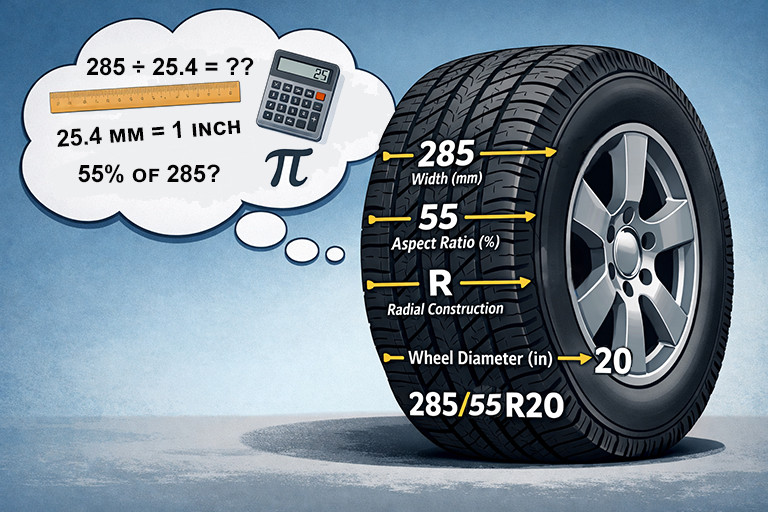
If you have ever looked at the sidewall of a tire and seen something like 275/55R20, you may have wondered what all those numbers and letters actually mean. Tire sizing can look confusing at first, but each part of the code tells you something important about the tire’s dimensions, construction, and fitment.
Understanding tire size is helpful whether you are replacing worn-out tires, upgrading your wheels, or choosing a new wheel and tire package for your truck or SUV. It also helps you compare tire options and understand how changes in size can affect ride height, clearance, speedometer accuracy, and overall appearance.
A Typical Tire Size Example
Let’s use this common tire size as an example:
275/55R20
Each part of that size has a meaning:
-
275 = tire width
-
55 = aspect ratio
-
R = radial construction
-
20 = wheel diameter
Some tires may also include extra markings before or after the size, such as:
LT275/65R20 126/123S
That adds more information, including the tire type, load rating, and speed rating.
Let’s break it all down.
The First Number: Tire Width
In 275/55R20, the 275 is the tire’s section width in millimeters.
This is the approximate width of the tire from sidewall to sidewall at its widest point, not the width of the tread that touches the ground.
What It Tells You
A 275 tire is about 275 millimeters wide, which converts to about 10.83 inches.
How to Calculate It in Inches
To convert millimeters to inches:
millimeters ÷ 25.4 = inches
So:
275 ÷ 25.4 = 10.83 inches
This gives you a rough idea of how wide the tire is.
The Second Number: Aspect Ratio
In 275/55R20, the 55 is the aspect ratio.
This number tells you the sidewall height as a percentage of the tire’s width.
The sidewall is the rubber of the tire that is above and below the wheel.
So in this example, the sidewall height is 55% of 275 mm.
How to Calculate Sidewall Height
Use this formula:
Tire width × aspect ratio = sidewall height
But remember to turn the percentage into a decimal first:
275 × 0.55 = 151.25 mm
That means the sidewall height is about 151.25 mm.
To convert that to inches:
151.25 ÷ 25.4 = 5.95 inches
So this tire has a sidewall height of about 5.95 inches.
Why Aspect Ratio Matters
A lower aspect ratio usually means:
-
shorter sidewall
-
sportier look
-
sharper handling
-
firmer ride
A higher aspect ratio usually means:
-
taller sidewall
-
more cushion
-
smoother ride
-
more sidewall flex
For trucks and SUVs, aspect ratio plays a big role in stance, ride quality, and how much sidewall you have for off-road use.
The Letter: Tire Construction
In 275/55R20, the R means radial construction.
This is the most common type of tire construction used today. Radial tires are built with internal cords that run perpendicular to the direction of travel, which helps with ride comfort, tread life, and stability.
You may occasionally see other letters, but R is by far the standard on modern passenger vehicles, trucks, and SUVs.
The Last Number: Wheel Diameter
In 275/55R20, the 20 is the wheel diameter in inches.
This tells you the size of wheel the tire is made to fit.
So this tire fits a 20-inch wheel.
Important Note
This number does not tell you the overall height of the tire. It only tells you the wheel size.
That is why two tires can both fit a 20-inch wheel but still have very different overall heights.
For example:
-
275/55R20
-
33x12.50R20
Both fit a 20-inch wheel, but their overall height is different.
How to Calculate Overall Tire Height
To find the tire’s total diameter, you add:
-
the sidewall height on the top
-
the sidewall height on the bottom
-
the wheel diameter
Formula
Overall tire diameter = (sidewall height × 2) + wheel diameter
Using our example:
-
Sidewall height = 5.95 inches
-
Wheel diameter = 20 inches
So:
(5.95 × 2) + 20 = 31.9 inches
That means a 275/55R20 tire is about 31.9 inches tall.
How to Calculate Tire Circumference
Circumference matters because it affects how far the tire travels in one full rotation. This can impact:
-
speedometer accuracy
-
odometer readings
-
gearing feel
-
shift points on some vehicles
Formula
Circumference = diameter × 3.1416
Using the diameter we just calculated:
31.9 × 3.1416 = 100.22 inches
So the tire travels about 100.22 inches per full revolution.
What About Tire Size in Flotation Format?
Some truck tires use a different sizing style, such as:
33x12.50R20
This is called flotation sizing.
Here is what it means:
-
33 = overall tire height in inches
-
12.50 = tire width in inches
-
R = radial construction
-
20 = wheel diameter in inches
This format is common on larger all-terrain and mud-terrain tires for trucks and lifted vehicles.
Metric vs. Flotation Example
A metric tire like 275/55R20 requires calculation to find total height.
A flotation tire like 33x12.50R20 gives you the overall height right away.
What Does “LT” Mean in a Tire Size?
If a tire size starts with LT, like:
LT275/65R20
the LT stands for Light Truck.
This means the tire is built for heavier-duty use, often with stronger construction for towing, hauling, or rougher conditions.
You may also see:
-
P = Passenger tire
-
ST = Special Trailer tire
-
T = Temporary spare tire
For trucks and SUVs, the difference between P-metric and LT tires can matter a lot depending on how the vehicle is used.
What the Numbers Do Not Tell You
A tire size gives you a lot of dimensional information, but it does not tell you everything.
It does not directly tell you:
-
tread pattern
-
load rating
-
speed rating
-
tire brand
-
whether it is all-terrain, mud-terrain, or highway
-
exact tread width
-
whether it will fit without rubbing
That is why fitment involves more than just reading the size.
Why Tire Size Matters
Knowing how to read tire size helps you:
-
compare stock and aftermarket sizes
-
estimate how much taller or wider a tire will be
-
understand sidewall height
-
plan for leveling kits or lifts
-
choose the right wheel and tire package
-
avoid rubbing, clearance, and speedometer issues
For example, if you move from a 275/55R20 to a 285/40R24, you are not just getting a wider tire. You are also getting a taller tire with a much larger sidewall, which can affect both looks and performance.
Quick Breakdown Example
Let’s break down 285/40R24 step by step.
Width
285 mm ÷ 25.4 = 11.22 inches
Sidewall Height
11.22 × 0.40 = 4.49 inches
Overall Diameter
(4.49 × 2) + 24 = 32.98 inches
So a 285/40R24 tire is about:
-
11.22 inches wide
-
4.49 (x2) inches sidewall height
-
32.98 inches overall height
That makes it noticeably taller than a 275/55R20.
Final Thoughts
The numbers in a tire size are more than just part numbers — they tell you the tire’s width, sidewall height, construction type, and wheel fitment. Once you understand how to read them, you can also calculate the tire’s overall height and circumference, which helps when comparing sizes or upgrading your setup.
Whether you are replacing stock tires or shopping for a more aggressive wheel and tire package, understanding tire size is one of the best ways to make a smarter decision.
When in doubt, always check fitment carefully and make sure the tire works with your vehicle, suspension, and intended use.